
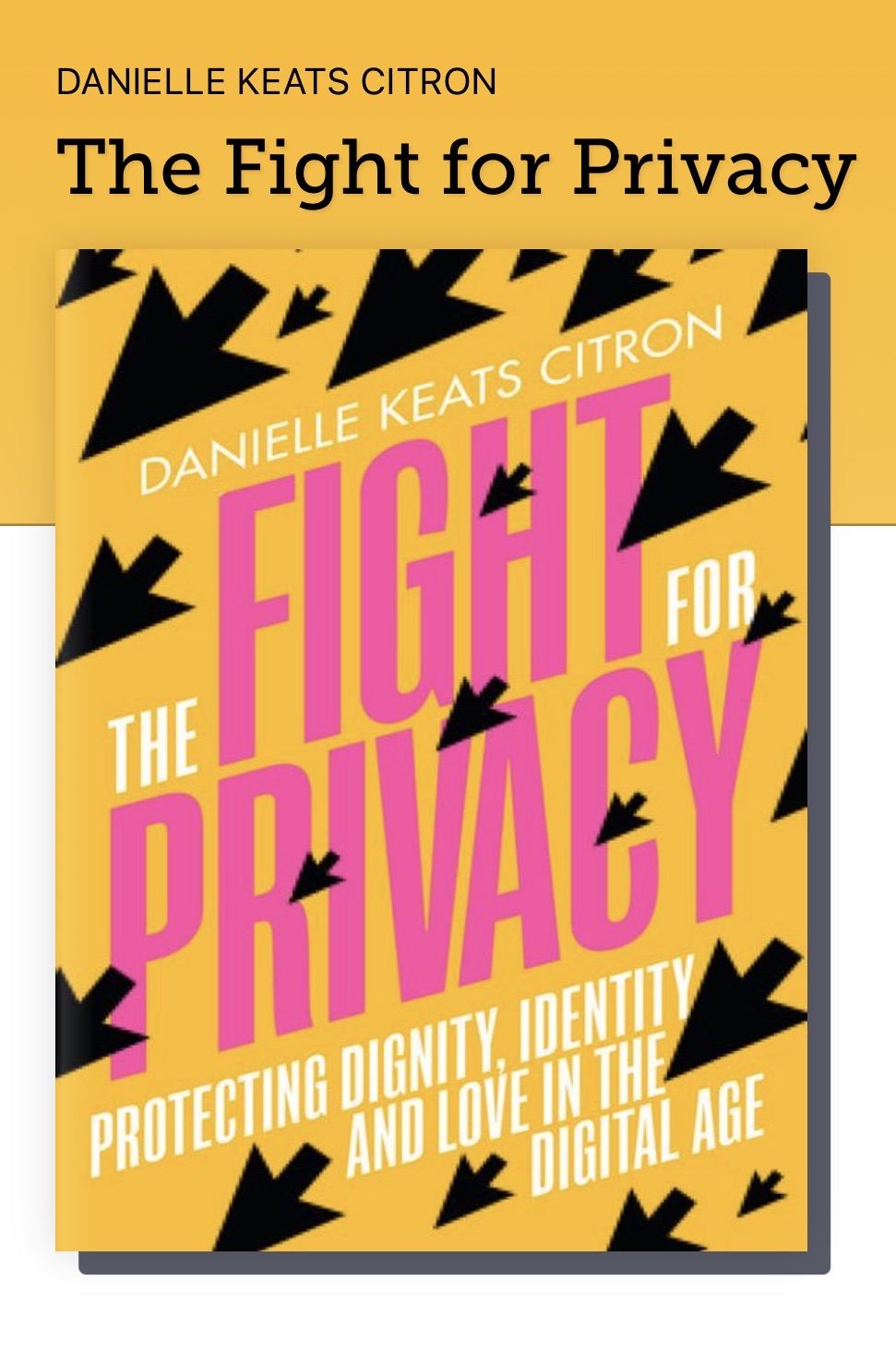
Sharing critical insights on the concerns of dating violence and privacy violations, and their potential implications, including further exploitation, surveillance, and other crimes committed by individuals, corporations, and law enforcement- by using excerpts from the book “The Fight For Privacy” by Danielle Keats Citron. Additionally, providing real-life stories and crucial advice to encourage individuals to assert themselves and overcome obstacles.
It is one thing to end a relationship, and another to discover that your intimate life has become a basis for surveillance.
While learning to safeguard your privacy is a commendable endeavor, it is equally concerning to discover that an intimate partner who once shared a close connection can transform into a predator. This individual may exert influence over others and potentially coerce law enforcement agencies into violating your privacy. Leaving a relationship due to such privacy violations is a valid reason for termination. However, it becomes a more complex situation once recognizing that you continue to experience the repercussions of these violations even after the relationship has ended since more individuals are now involved and may not share your best interest.
This draws many questions, “Why?” , “How does crimes like this happen?”, “How does one recover?”, “ How to Report it?”, “What person is capable of doing this?” “Where does this happen?”, Addressing the challenges of maintaining a healthy dating relationship necessitates a comprehensive understanding of its characteristics and the importance of self-protection. Furthermore, it is crucial to consider additional pertinent questions, such as:
• When faced with limited resources, how can an individual effectively protect their privacy from potential violators?
• How can individuals effectively preserve their well-being and prevent their lives from being squandered by individuals who prioritize self-interests over your safety and well-being?
I anticipate sharing what I have learned from my short dating experiences, and providing advice on protecting oneself from the various stages of dating violence in the 21st century.
This advice is particularly useful for meeting new people until one has matured enough to understand communication.
I will also share excerpts from a book authored by Danielle Keats Citron, titled “The Fight For Privacy: Protecting Dignity, Love, and Identity in the Digital Age.” I was fortunate to come across this book at my beautiful & clean & state of the art library.
Educational and Literary Insights
Danielle Keats Citron’s book, The Fight For Privacy: Protecting Dignity, Love, and Identity in the Digital Age, provides critical insights into issues of intimate privacy, legal protections, and the impact of technology on personal safety. This resource is particularly valuable for young adults, women, and anyone navigating the complexities of digital-era relationships.
Conclusion
Addressing dating violence and privacy violations requires both personal vigilance and societal awareness. By sharing my experiences, I aim to empower others to protect their dignity, seek justice, and approach intimate relationships with informed caution. The path to recovery involves understanding the risks, using legal and technological resources, and prioritizing one’s emotional and physical safety.
My Personal Experience With Dating Violence and Privacy Violation
When I was 18 years old, I met a guy who was in his mid 20s or late 20s. I believe he was interning as a college advisor and I also worked with him at one point.
He had commenced and internship at my college after the first semester. Initially, this arrangement fostered a unique connection, which unfortunately evolved into a coerced relationship. This relationship was subsequently exploited by him to exert control over my interactions with other individuals I held dear. Regrettably, his actions resulted in significant personal distress. Despite our close relationship during my college years, his position as a college advisor granted him privileged access to my academic schedule.
Through other people he made my college experience difficult. He also stalked me when I paused my education to focus on my career.
Years afterwards when I moved to Washington DC, I realized that he was apart of a network of people who did I this and that there were different levels to the violations he committed.
I was very greatful for my best friends who protected me from him.
Personal advice:
To always try to understand very well to what your loved ones have to say and be respectful, regardless the situation. “Nah matta wah gwan ahn”.
Establish healthy boundaries, while also expressing your assertion and respect.
Be mindful of the people you let into your personal life and the their influence.
“People that truly care for you, know you well. Your parents should be wiser than you.”
Follow traditional values and wise sayings, and trust your instincts- in order to obtain guidance.
“Take seriously what men say and do. They mean what they say and do, therefore nothing is a coincidence or should be taken lightly.”
Obtain a lawyer before talking to law enforcement, if possible. Also obtain an educational lawyer.
When it comes to socializing on campus or working, one must be mindful of how they share personal information and should consider utilizing an alternative number for that purpose.
**What My Experience Taught Me About Privacy and Securing Oneself**
– I always knew how very important it is to do background check on individuals. I learned that it is much more important to be able to conduct background searches and to report on individuals, period.
– Learn how to identify if you are a victim of a crime and assert your rights. Keep your thoughts to yourself.
– I learned that Google is not secure, Gmail is unsecured and a horrible choice of service for individuals serious about securing their privacy.
– There are more fraudulent & pervert individuals lurking around everywhere, waiting to seek you at the right opportunity, especially in New York City. The City that never sleeps and is the first place people want to be, is over populated, is popular for emigrants and now migrants. People are always looking to exploit information, to benefit themselves.
– College is a business. Avoid mixing your personal, and professional, and school relationship together. Should you experience any situation, it is best to have a lawyer involved first, prior to and after alerting police.
– Lawyers run colleges.
– One should be very serious and avoidant about police and security guards, keeping interactions very minimal. They have the time and resources to exploit individuals, possess cybersecurity skills, and can send individuals to interfere with you. Despite their badges, they too are individuals capable of committing fraudulent crimes or misconduct. Individuals- with majority being black & otherwise people of color, fall into the category that can easily lead to discrimination & racial profiling.
– It is advantageous to maintain distinct contact and phone numbers for various groups and settings. This practice ensures that communication remains organized and efficient, and prevents simple privacy violations.
– Courses in Criminal Law, Cybersecurity and Law and Anthropology are important to consider.
– Colleges should implement simple lectures regarding campus safety specifically awareness of trafficking & exploitation, and prevention and reporting. Teaching students to confidently address any unwanted pervasive and fraudulent behavior that takes place on educational grounds causing interferences to students ability to complete their education.

Leave a Reply